An "old" article and video but very interesting anyway.
Showing posts with label butterflies. Show all posts
Showing posts with label butterflies. Show all posts
Monday, August 23, 2021
eScienceCommons: The monarch butterfly's medicine kit


Thursday, August 31, 2006
To Whom It May Concern (or not):

I'm going to indulge in a bit of rambling today. It seems I'm feeling a little lost, no not lost, but disoriented. Sometimes the Earth seems to not be spinning just right on its axis so that I get a little topsy-turvy. In my reading about butterflies I learned that it's probably some kind of magnetic thing that guides Monarch butterflies in their sometimes thousands-of-miles-long migrations. Well, if a butterfly can have some kind of magnetic thing then why can't I? ;-) And though I don't really know much about any of that stuff I have read that the Earth's magnetic poles are shifting and that they have always done this. Anyway, whatever. Unfortunately, I'll probably never learn exactly why I feel this way sometimes.
I've had several posts started, but I can't seem to finish any of them yet. Primarily, I've been thinking about Cognitive Pyschology and Spirituality, Feminism (pros and cons, but mostly cons), the problems with Anthropic reasoning, Biological vs. Environmental Influences, Tricksters in History, and Magic Words and Alchemy. Is your head spinning yet? Mine is. LOL Maybe it's more than my poor little brain can handle.
Anyway, I just know there is some thread of something that will lead me back to my point. Whatever that is. You see, I'm so disoriented that I can't even decide if I need to go forewards, backwards, up, down, or what.
It's raining today. It's a nice steady rain, and while I was soaking in a hot bath (I hurt my back over the weekend) I opened the window over the tub so I could listen to the rainfall. I wish I could say it offered some relief or insight, but it didn't. It just sounded nice. Even Nature is ignoring me today.
And even writing this rambling piece of nothing I'm losing my way. David left very early this morning to go to Florida for a few days with his dad and brother. The disorientation isn't related to that because it was happening previous to that. I hope he has fun. He rarely gets to take any kind of break like that. And it's important now because his dad just had colon cancer surgery a few weeks ago. They got it all, but he's starting some chemo after he gets back as a precaution.
I've got some kind of spider or bug bite on my foot. It could be a brown recluse bite, but I didn't see what did it. I've had a couple of bites like this before. It's very painful and a little swollen. It will heal but leave a scar like the others. I wonder if I get bitten enough will I be like Spiderman? That would probably suck. Superheroes have hard lives. ;-) So does the Trickster. Both do tend to get beat up a lot, either from bad guys or people who don't like what you have for them. Don't look a gift horse in the mouth, they say. I don't know if it's really possible not to. Be kind to your critics if you can shut them up that way, but if you can't, beat the shit out of them. LOL It doesn't pay to be moderate with some people because they'll just stab you in the back next chance they get. Et tu, Brute?
Well, it's time for me to go pick up the kids.
Friday, August 11, 2006
Got the Butterflies All Tied Up

This is a Gulf Fritillary (Agraulis vanillae incarnata) just after emerging from its chrysalis, expanding its wings, and preparing for its last stage of life. The photo really doesn't do justice to its exquisite beauty and opalescent coloring (I wonder if the coloring is why it's named 'vanilla incarnate'). This photo was the other on display at the Dogwood Arts Festival Photo Show in April along with 'Splendid Anomaly.'
This post has been a long time (several months) coming. One problem was that I just could not think of the right title to 'tie it all up'. Then a few weeks ago (yet more delays) I heard the Prince song "When Doves Cry" on the radio followed by Eddie Money's "Take Me Home Tonight." It was the 'random' juxtaposition of these two songs that somehow connected for a solution. Hearing in the second song, "I can feel you breathe; I can feel your heart beat faster.....faster," caused a 'free association' (see, female verbal pattern thinking can be pretty cool) to the first song:
Touch if u will my stomach
Feel how it trembles inside
You've got the butterflies all tied up
Don't make me chase u
Even doves have pride
I've been somewhat obsessed with butterflies for the last several years. This obsession with butterflies was born in December 1999, when in Puerto Rico exploring Old San Juan we stumbled upon The Butterfly People. I was instantly caught in the "butterfly dimension" and butterflies (click for a brief description of some cute shamanic totem animals including butterflies) began to enter my life in various ways. Living in the country for the last 5 years has made it possible for me to have hands-on studies of them. In the summers my friends have teased me about my jars of caterpillars and chrysalides lined up on the kitchen bar. But they've never complained when they got to watch a butterfly fly for the first time. (However, this year the kitchen bar has been dominated by the black widow spider jar, and that has been the source of even more teasing about me really finally 'losing it.' lol But I think that the spider's presence, until her recent death, fit nicely with the symbolism of tied-up butterflies.)
I've recently finished reading the book, An Obsession With Butterflies, by Sharman Apt Russell. The first few sentences of the book immediately intrigued me:
In physics, string theory suggests that there are more than four dimensions, perhaps ten in all. [I thought it was 11.] These extra dimensions are curled up into a very small space, big enough only for subatomic particles, or tiny loops of vibrating "string." The theory does not rule out more dimensions, perhaps in the area of time. These dimensions, here but not here, exist outside our range of perception.
Adding butterflies to your life is like adding another dimension.
Russell goes on to describe examples of the richness and complexity of activities happening in the world all around us that we never even notice or perceive at all. Always surrounding us there are countless chemical messages being passed between flowers and insects (as well as other animals and plants) that exist in what can seem like dimensions other than our own. (I might could call it the "Olfactory Dimension".) She describes many examples of the hidden behavior that occurs in the butterfly world and how that behavior and other traits evolved in concert with the evolution of plants and other animals.
Let me indulge in a bit of quoting of out context. Czech string theorist Lubos Motl (who told me his name coincidentally is very similar to the Czech word for 'butterfly'- motyl[missing its proper accent thingy], which is much easier than the Aztec name of one type of butterfly, xiquipilchiuhpapalotl) says:
The punch line is that we absolutely need string theory to understand what's really going "inside" various physical systems that depend on nice mathematics. For an intelligent person, it is impossible to deny that string theory connects A,B) with C,D) and with E). It allows us to make seemingly obscure but true relations as clear as the sky. String theory allows us to answer questions in each category. It even tells us what are the right questions and what are the wrong questions. It also informs us which similarities, isomorphisms, and identities are deep and which of them are just random coincidences.
...
Our understanding of such dual systems is necessary if we want to predict what happens behind the borders between our current knowledge and our current ignorance. Sometimes the borders of the hostile empire of ignorance are only defined by our limited calculational skills. Sometimes the borders occur because without string theory, we would have no idea how to define the theory of the physical phenomena in the first place...
I know that he's not talking about butterflies and their seemingly extra-dimensional communications with flowers and other insects. But it's a fun thought to try to take complex theoretical physics and 'apply' it to events in the 'real' world. Russell does this with her opening paragraph, but that wasn't quite enough for me because I had hoped she would explicitly weave that idea into the rest of her book. I like to dig a little deeper and 'see' the connections in more detail. Or at least with my limited understanding of string theory it seems to fit together pretty well in that metaphorical sense. And I do want to emphasize the word "metaphorical" here because at this level that is all I can do to connect string theory and butterflies. I'm only describing an analogy or metaphor as I perceive it. I'm not capable of explaining why or how. (link to an explanation of various ways of looking at the Universe) However, I do think that when a theory begins to be used as a metaphor for real events that it means it is gaining acceptance in the minds of non-scientists. There is so much more going on in the world around us than the tiny bit that we do perceive. I like the use of String Theory as metaphor even if it might not be 'analytically correct'. It is philosophically pleasing.
I enjoyed the first half of Russell's book more than the rest because she discussed in detail some scientific observations of butterfly behavior and the complexity that has evolved (and continues to evolve) in relation to other animal and plant behaviors. Butterflies and ants in particular have established close symbiotic relationships:
Over 2000 species of butterflies around the world suffer from myrmecophily. They are ant-loving. (page 32)And this dynamic symbiosis is present with flowers too, though these relationships rely on a balance of needs by each participant and seem to constantly change/adjust in small ways which is, of course, the point of evolution. But this interconnectedness isn't limited to animal-animal or animal-plant relationships. For example, in many species their developing coloring responds to temperature changes, but that ability is lost in butterflies bred in climate controlled labs in fewer than 20 generations. Apparently, climate change is necessary for adaptability and evolution. Whoda thunkit? ;-)
There is also a discussion of the unique characteristic of caterpillar blood that seems to 'count time', a true biological clock. This is only one of the discussions in the book that makes it so worthwhile and thought provoking. I highly recommend this book to anyone who appreciates the complexity and 'connectedness' of Life even down to the smallest, most common of creatures. (And it's a small book and a quick read, provided you don't have kids constantly interrupting you.)
In her discussions of the history of butterfly study, lepidopterology, we learn that Vladimir Nabokov was an avid and well-known 20th Century lepidopterist. Many of us know him for his controversial novel, Lolita, about, as most of us know, a pedophile's pursuit and 'capture' of a young girl. (I haven't read it, and I will admit that it could have literary value despite the subject which I find disgusting.) Apparently, Nabokov was obsessed with butterflies too, especially their metamorphosis from a "bag of goo" (Russell's description) to a beautiful work of biological art. Russell sums it up by saying:
It is a gesture of beauty almost too casual. (page 48)"A gesture of beauty almost too casual" seems to me to be expected from an "Elegant Universe."
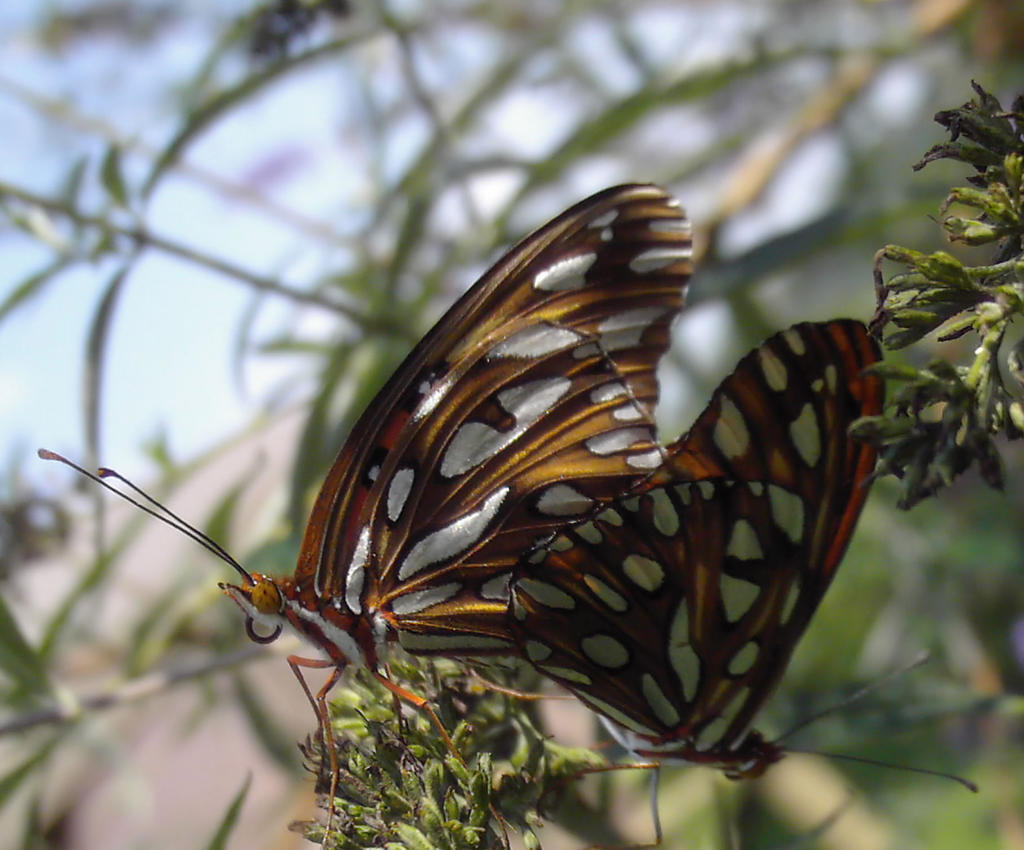 When gulf fritillaries are mating they stay connected for most of a day.
The primary purpose of the adult butterfly is reproduction. And butterfly sex is almost as varied as human sex. Some species like the Monarch (Danaus plexippus) engage in 'rape' or what looks to us like forced, uninvited sex, and is probably the result of the male Monarch lacking enough pheromones to properly 'attract' a female. Other species like the Zebra Longwing (Heliconius charitonia) engage in pupal sex, or what could be compared to pedophilia in humans, though in the butterflies it does often result in actual reproduction but also sometimes results in female death. This barbaric practice in butterflies has evolved probably as a result of intense male competition to perpetuate their own genes. They even sometimes engage in interspecies pupal mating (which kills the female) probably to reduce competition on host plants. (A disturbing thought is that perhaps human pedophilia is an evolutionary relic which has yet to completely disappear.) And some butterfly species have even developed a form of 'bondage' (or being "tied up") with a structure called a "sphragis" which Russell equates to a "chastity belt" that keeps other males from mating with a female. However one male butterfly sexual feature that I'm sure most human males would wish they had are rudimentary 'eyes' on their genitalia that detect light and probably assist the males in properly 'lining up' with the female genitalia.
Gulf fritillaries are probably my favorite butterflies for several reasons. They are plentiful here so I have gotten to watch them quite a bit. They have the coolest scientific name ("vanilla incarnate"), and they feed on the Passion Flower plant (Passiflora incarnata or roughly "widespread goddess of flowers incarnate") which grows wild around here and is quite beautiful and smells incredible:
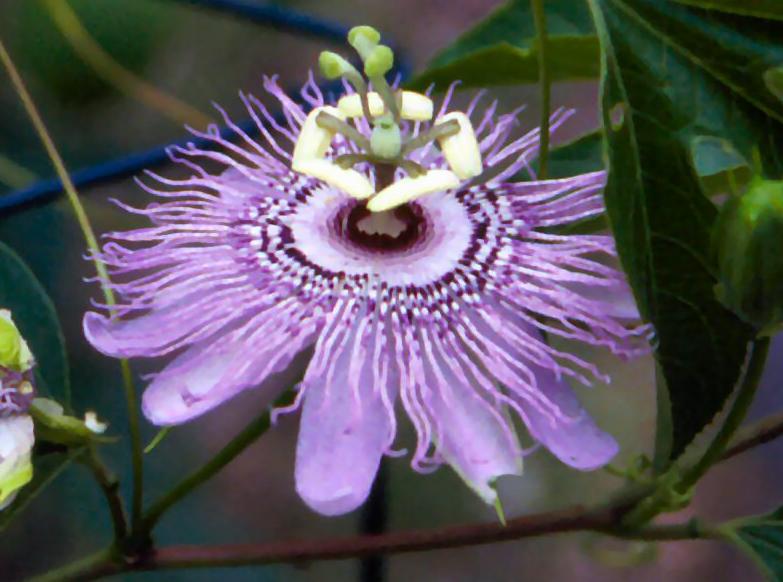 Maybe their feeding on this Passion Flower is part of why their mating lasts so long? And it seems logical to me to think that they must surely be having little butterfly orgasms even though we've yet found a way to detect them. (Why would they stay connected so long if wasn't very pleasurable? Staying connected for long periods increases the risk of being eaten by a bird or other predator so you'd think there has to be some big benefit to offset that danger.) Maybe these butterfly orgasms are occurring in another dimension, a curled-up dimension predicted by string theory that we've also yet to detect? Maybe someone should try to study this further? Maybe this is the answer so many have been searching for? ;-)
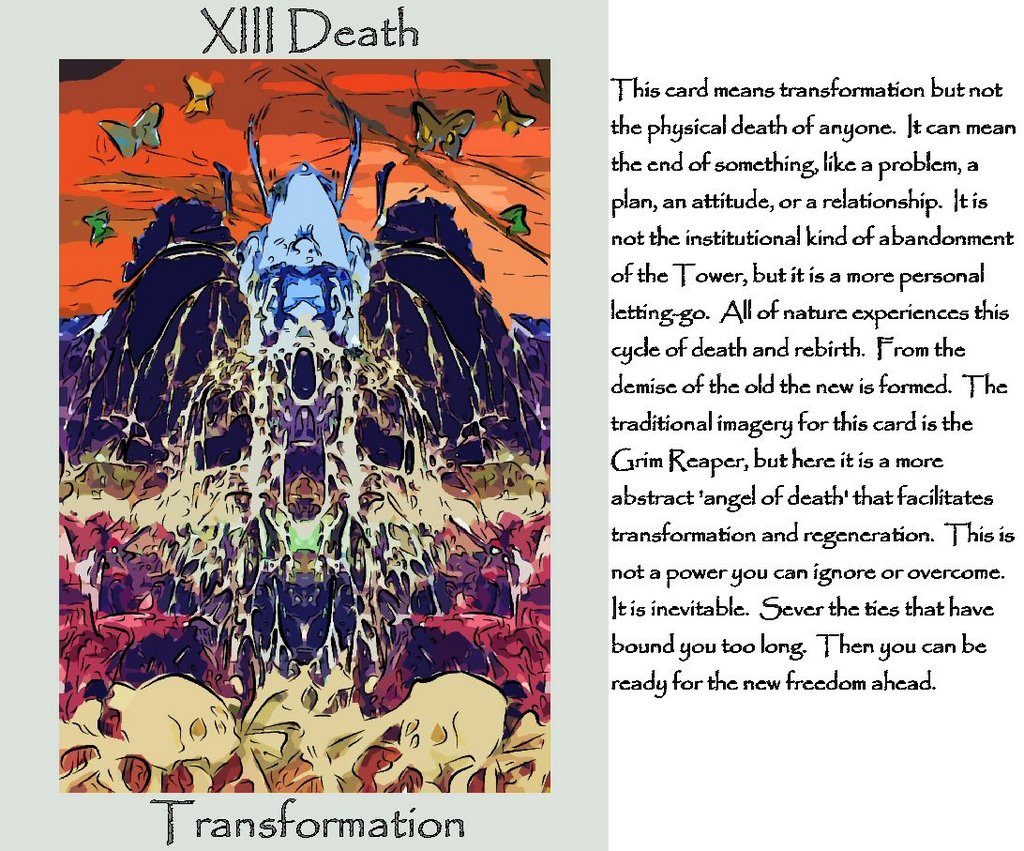
I'd like to leave it here with that 'punchline', but no discussion of butterflies and the significance of their lives and life-cycle is complete without mentioning death. Butterflies, like most of us, live then reproduce and then die. It's the Way of Life. In Russell's book there is a brief discussion of the cross-cultural spiritual symbolism of butterflies' metamorphosis. Many cultures have independently associated this metamorphosis with the life/death/rebirth cycle of Life, and some have associated it with reincarnation. Some say that butterflies are the souls of dead humans. Here is an iconic representation of this idea:
Of course, there is much in the book that I haven't mentioned, but that's why you need to read it. Now that I've come to the end of this I'm wondering if it was worth the trouble, but I'm relieved to have it finally finished.
A quick disclaimer here: this is for entertainment purposes only. ;-)
Tuesday, August 16, 2005
Tuesday Tidbits
It's been an ever busier Tuesday, and I will catch up on reading blogs tomorrow. But here are a few morsels of Hoeness until then...
- the correct shipment from Corel was here before noon today. That was FAST!! They sure did make up for sending the wrong thing and making me stay on the phone for over half an hour yesterday.
- most of today was spent getting a bunch of tomatoes ready for canning. I forgot how long it takes to do all the prep work. Here's a fun little tip in case anyone didn't already know it. To make peeling tomatoes (and peaches) quicker and easier pour boiling water over them and let them sit in it for about a minute. The skin just slides right off. (But it still takes a long time to do a sink-full of Roma tomatoes.)
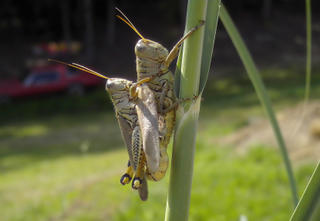
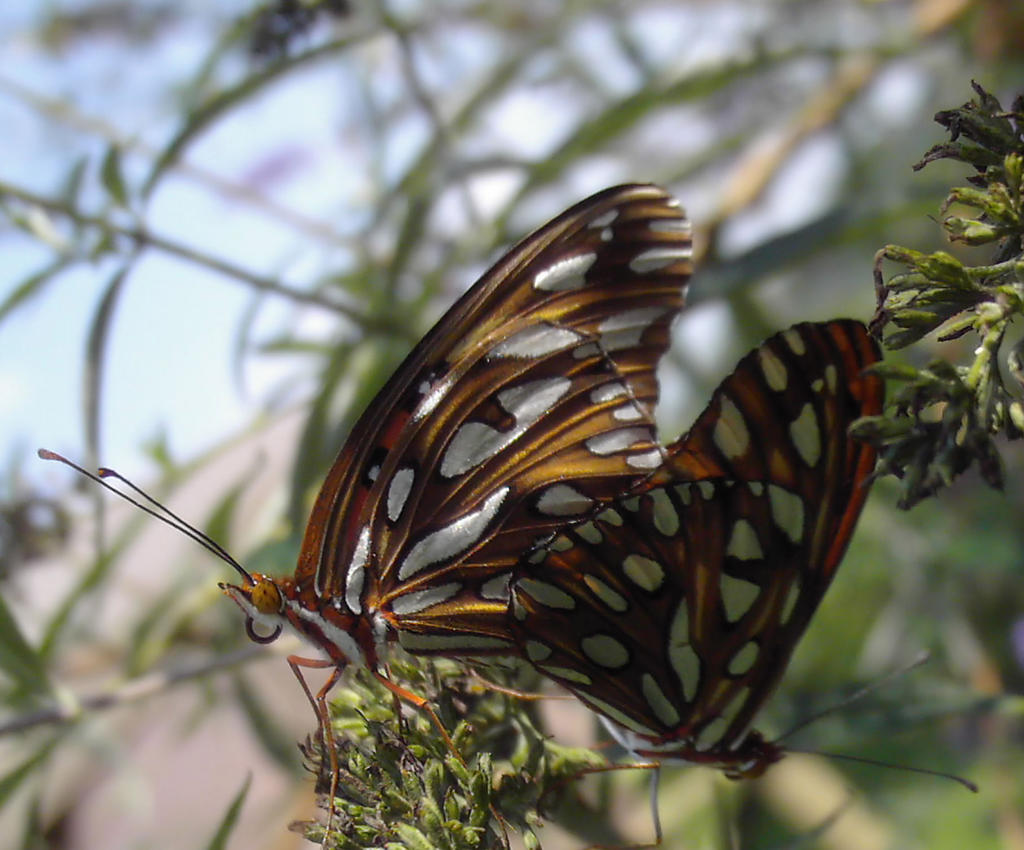
- and here is some insect pornography for your viewing pleasure (or disgust)...
Butterfly lovin':
Grasshopper lovin':
- the correct shipment from Corel was here before noon today. That was FAST!! They sure did make up for sending the wrong thing and making me stay on the phone for over half an hour yesterday.
- most of today was spent getting a bunch of tomatoes ready for canning. I forgot how long it takes to do all the prep work. Here's a fun little tip in case anyone didn't already know it. To make peeling tomatoes (and peaches) quicker and easier pour boiling water over them and let them sit in it for about a minute. The skin just slides right off. (But it still takes a long time to do a sink-full of Roma tomatoes.)
- and here is some insect pornography for your viewing pleasure (or disgust)...
Butterfly lovin':
Grasshopper lovin':

Saturday, May 07, 2005
Totem Hoe
About three years ago I had a session with a shaman who told me what some of my totems are. My main one is a mouse. Yeah, a lowly little mouse, but it's pretty accurate because mice are detail oriented and like to store things and dig, like a hoe. Mouse medicine is Scrutiny and Analysis which is good and bad. There is such a thing as over-analyzing and picking apart stuff. Oh, I know that all too well. This very blog is an exercise in that. Some of my other totems are hummingbird, butterfly, dragonfly, lizard, and spider. I know there are some others, but I will have to look back at my old notes and see if I wrote all of them down.
Hummingbird medicine is pure joy. They flee from conflict and ugliness, yet they are quite fierce and tough when they need to be. They exist to bring about happiness and help us find joy in all we do. They also teach us how to use flowers for healing. Hummingbirds will die if caged.
Butterfly medicine is transformation. The life cycle of the butterfly goes from egg, to larva (caterpillar), to pupa (chrysalis), to adult. The transformation from that occurs in the chrysalis is such a mystery. How a soft, wormy thing can become a beautiful, winged insect is amazing and representative of the potential change within us all.
Dragonfly medicine is illusion and the power of light. Dragonfly knows that the way in which things reflect and absorb light determines how they are seen. Dragonfly reminds us to remember that we can change how we perceive things, that we can shine the light on our illusions to help us see the truth.
Lizard medicine is subtlety and keenness of perception. Lizard can feel the vibrations and heat of their insect prey as they move. And Lizard's eyesight can detect the slightest movements. Lizard medicine is clairvoyance and the ability to bridge the conscious and subconscious, as in dreaming. Sometimes Lizard is called the Dreamer.
Spider medicine is creativity and the weaving of fate. By spinning its web Spider is creating the Universe and the fate of all who enter that web. Spider is a creator but is also a destroyer. If you are caught in its web when its hungry you might become its next meal. But we have to remember that feeding the creator is just as honorable and important as any other destiny.
Just like a totem pole this totem hoe has many components. We all do. None of us are just simple sticks, well, except maybe pitch forks.
Hummingbird medicine is pure joy. They flee from conflict and ugliness, yet they are quite fierce and tough when they need to be. They exist to bring about happiness and help us find joy in all we do. They also teach us how to use flowers for healing. Hummingbirds will die if caged.
Butterfly medicine is transformation. The life cycle of the butterfly goes from egg, to larva (caterpillar), to pupa (chrysalis), to adult. The transformation from that occurs in the chrysalis is such a mystery. How a soft, wormy thing can become a beautiful, winged insect is amazing and representative of the potential change within us all.
Dragonfly medicine is illusion and the power of light. Dragonfly knows that the way in which things reflect and absorb light determines how they are seen. Dragonfly reminds us to remember that we can change how we perceive things, that we can shine the light on our illusions to help us see the truth.
Lizard medicine is subtlety and keenness of perception. Lizard can feel the vibrations and heat of their insect prey as they move. And Lizard's eyesight can detect the slightest movements. Lizard medicine is clairvoyance and the ability to bridge the conscious and subconscious, as in dreaming. Sometimes Lizard is called the Dreamer.
Spider medicine is creativity and the weaving of fate. By spinning its web Spider is creating the Universe and the fate of all who enter that web. Spider is a creator but is also a destroyer. If you are caught in its web when its hungry you might become its next meal. But we have to remember that feeding the creator is just as honorable and important as any other destiny.
Just like a totem pole this totem hoe has many components. We all do. None of us are just simple sticks, well, except maybe pitch forks.
Subscribe to:
Posts (Atom)